


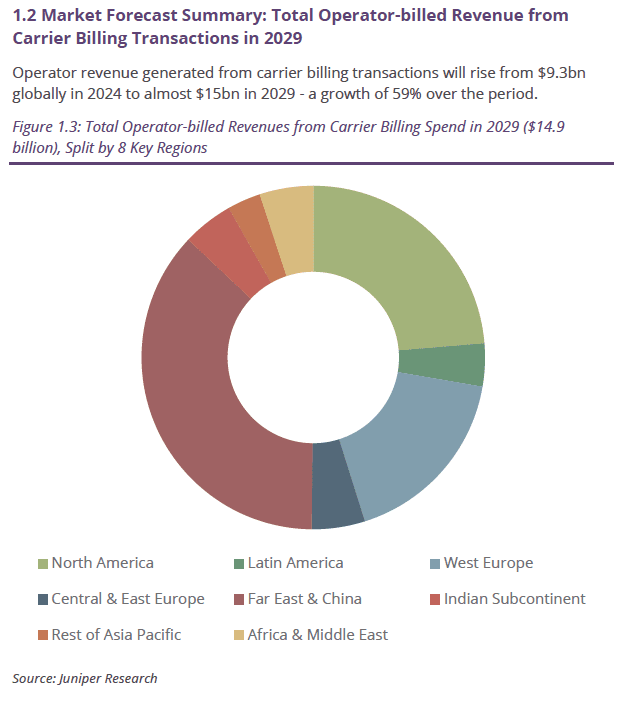
Operator revenue generated from carrier billing transactions is set to rise from $9.3bn globally in 2024 to almost $15bn in 2029 – a growth of 59% over the period.
This steady growth will be driven by an increased consumer awareness of the payment method and the growing need for telcos to find new revenue streams, finds the study by Juniper Research.
Find out more about the new report, Global Carrier Billing Market 2024-2029, or download a free sample.
As the price of SMS traffic continues to rise significantly in most markets over the last two years, with the average price of an SMS business message rising from $0.019 in 2021 to $0.023 in 2024, both mobile subscribers and enterprises are looking for alternative non-operator led channels for communications, including OTT messaging apps and network APIs (Application Programming Interfaces).
This has opened a space in the market for carrier billing, as it is not subject to barriers for MNOs such as refunds, delayed messages, scams, and malware. Carrier billing enables customers to make payments by adding the charge to their phone bill, rather than using a payment card or bank transfer.
Additionally, as subscribers already have a direct billing relationship with their mobile operator, carrier billing can improve customer loyalty by offering a convenient payment option directly linked to the user’s mobile account. As these subscribers will already share their payment details with their operators, carrier billing has the opportunity to reduce churn rates, as it allows subscribers without access to traditional payment methods such as credit cards to make payment for goods.
Not only can carrier billing provide an alternative payment method for mobile subscribers, but, by facilitating transactions, this technology can also increase market share for the purchase of digital goods in markets where traditional banking infrastructure is weak or non-existent.
Mobile payment APIs become key
The key to making it work, stresses the study, lies in the introduction of standardised APIs (Application Programming Interfaces). These APIs, it says, will enable network operators to increase the speed of carrier billing roll-outs, reduce reliance on third-party aggregators and increase end-user availability.
The report urges MNOs (Mobile Network Operators) to deploy standardised APIs, including the Carrier Billing Checkout API, to reduce time-to-market; improving scalability and ensuring compliance with stringent payment regulations. This standardisation will strengthen the MNO’s position and influence within the digital payments ecosystem.
Standardised APIs will reduce MNO reliance on third-party aggregators, boosting their revenue share from carrier billing transactions. However, limited API availability in key markets such as Africa and the Middle East makes ongoing collaboration among MNOs, aggregators, content providers, and regulators essential for sustaining carrier billing growth.
Research author Elisha Sudlow-Poole says: “Over the past decade, MNO services such as voice, messaging, and data have become increasingly commoditised, leading to significant revenue loss. Carrier billing allows MNOs to diversify their revenue streams by acting as a distributor and payment facilitator for third-party services. Standardisation enables MNOs to accelerate carrier billing availability, making it a more viable alternative to competing digital payment methods.”


