





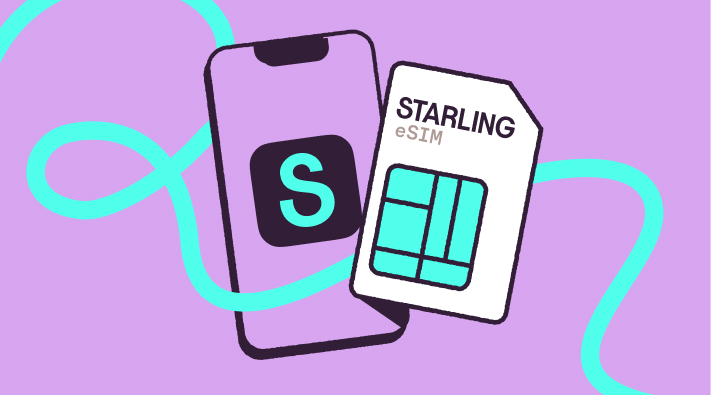
Starling Bank has launched an eSIM service offering customers mobile data in more than 130 countries, extending its travel proposition beyond payments and underlining how connectivity is becoming an embedded feature for banks, retailers and other consumer brands.
The UK digital bank has partnered with mobile services platform Gigs to offer customers a choice of 1GB, 3GB, 5GB and 10GB data plans, which can be purchased directly through the Starling app.
Each plan lasts for 30 days and can be bought before travelling, activating automatically when the customer reaches their destination. Additional data can also be purchased while abroad.
According to Starling, the eSIM connects customers to the best available network within Gigs’ provider footprint at any given moment. Its introduction is designed to complement the bank’s existing travel services, which include fee-free card spending overseas, a daily fee-free ATM withdrawal allowance of £300 and in-app tools for monitoring holiday spending and exchange rates.
“When Starling launched ten years ago, our fee-free travel offering set the bar for traditional banks to follow. Our travel offering remains industry leading, and our eSIMs add to the convenient experience our customers love us for,” says Bernadette Smith, Chief Customer and Banking Officer at Starling.
One notable feature is that customers will retain access to the Starling banking app even after using their eSIM’s data allowance. This means they can continue to manage their money, monitor transactions and top up their data without incurring additional roaming charges.
That arrangement removes a potentially significant point of friction. Running out of mobile data overseas can leave travellers unable to access banking apps precisely when they may need to check a payment, freeze a card or transfer money. By keeping its own app available, Starling is making connectivity part of both its customer experience and its security proposition.
The eSIM joins Starling’s existing collection of travel tools, including Spending Trackers, custom Tags for individual trips and its Travel Hub, which provides real-time exchange-rate information for a customer’s destination.
“Starling is already the UK’s trusted travel companion for fee-free and secure spending abroad. The key piece missing was staying connected overseas,” adds Hermann Frank, CEO and Co-Founder of Gigs. “Starling’s eSIM completes the travel toolkit, with users online the moment they hit the tarmac. This is the future Gigs is building: daily essentials seamlessly baked in and available with a tap, wherever customers need them.”
Connectivity becomes an embedded service
For the telemedia industry, the significance of the launch extends beyond the relatively crowded market for travel eSIMs.
Starling is not attempting to become a conventional mobile operator. Instead, it is embedding a highly relevant connectivity product inside an established customer journey. The bank already knows when and where many of its customers travel through card transactions, currency searches and the use of its travel tools. Adding an eSIM allows it to serve another immediate requirement without sending the customer to a separate mobile provider or specialist travel app.
This points towards a wider shift in the distribution of mobile services. Connectivity is increasingly becoming something that can be added to another brand’s proposition in much the same way as insurance, payments, loyalty rewards or credit.
The development of eSIM technology and cloud-based mobile enablement platforms means brands no longer need to build a conventional telecoms operation to offer mobile services. Partners such as Gigs can handle much of the network integration, provisioning and service infrastructure, while the customer-facing brand concentrates on distribution and the user experience.
That creates an important opportunity for eSIM platforms, mobile virtual network enablers, aggregators and wholesale connectivity providers. Banks, travel companies, retailers, airlines and membership businesses all have large customer bases and identifiable moments when connectivity can add value. The technical providers that make it possible for these businesses to launch branded services quickly could therefore find themselves serving a much broader market than traditional MVNOs.
Starling’s move also follows a growing wave of non-telecoms brands entering mobile. Retailers including Lidl and AO have recently developed mobile propositions of their own, illustrating how connectivity is being used to deepen customer relationships, create new revenue streams and keep users within a brand’s digital ecosystem.
The Starling proposition is particularly interesting because the commercial opportunity is tied to context rather than simply price. Customers are offered data when they are preparing to travel and are likely to be thinking about roaming costs, spending and access to essential apps. The eSIM consequently becomes part of a broader travel bundle rather than an isolated telecommunications product.
For Starling, that could generate additional revenue while increasing engagement with its app and strengthening its position as the customer’s primary travel account. It also gives the bank another reason to remain visible throughout the holiday journey, from planning and currency checking to spending, connectivity and post-trip analysis.
For telecoms providers, however, it also demonstrates how the consumer relationship is shifting. The network may still deliver the connectivity, but the bank owns the interface, understands the customer context and controls when the service is offered.
That does not necessarily diminish the telecoms opportunity. It changes where the value lies. As more brands seek to embed mobile data into their products, the growth market may increasingly be in providing the APIs, orchestration, compliance, network access, billing and support capabilities operating behind the scenes.
Starling’s eSIM may be presented as another convenient travel feature, but it is also an example of a potentially much larger development: mobile connectivity becoming an invisible, embedded component of everyday digital services – and one that customers may increasingly buy from brands other than their mobile operator.