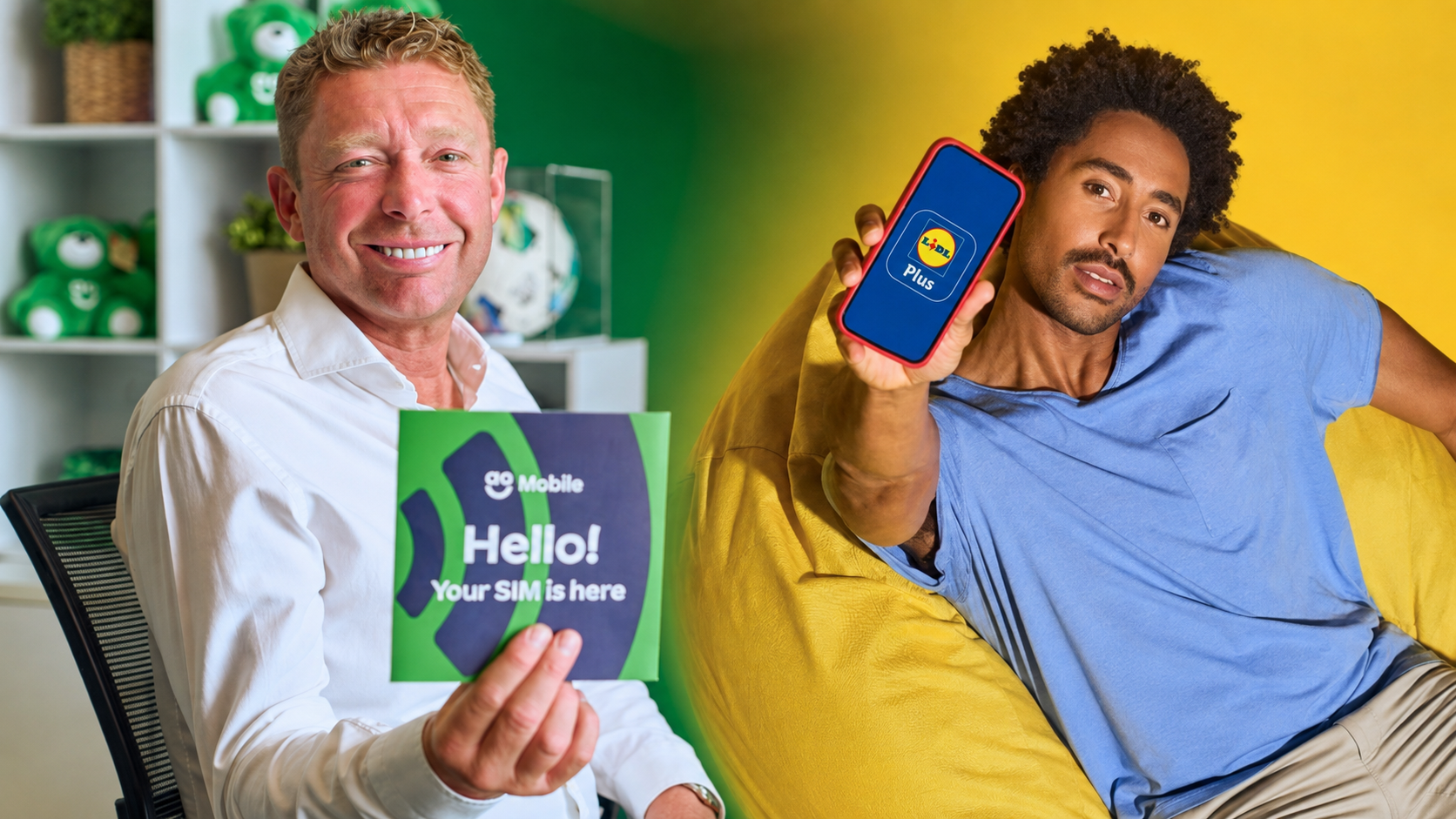
AO has launched its own UK mobile network, while Lidl is preparing to become an MVNO across its European markets, as retailers, banks and other consumer brands increasingly turn connectivity into a loyalty tool, recurring revenue stream and extension of their digital ecosystems.
AO Mobile has gone live with a single SIM-only tariff offering 500GB of data, unlimited UK calls and texts, 15GB of EU roaming and 5G connectivity on the Vodafone network.
The 30-day rolling plan costs £12 per month for members of the electrical retailer’s AO membership programme and £18 for non-members. Customers can choose a physical SIM or eSIM and attach up to nine additional SIMs to one account, positioning the offer as both an individual and family proposition.
AO’s move comes as Lidl prepares a much wider expansion of its Lidl Connect proposition through a five-year partnership with international connectivity platform 1GLOBAL.
Lidl’s parent, Schwarz Group, is acquiring a 9.9% stake in 1GLOBAL, which will become the group’s exclusive mobile connectivity technology partner. The companies plan to introduce national connectivity services across Lidl’s markets, integrating them with the Lidl Plus loyalty app.
Unlike a straightforward branded reseller arrangement, Lidl intends to become an MVNO itself. It will work with 1GLOBAL and local mobile network operators to tailor its service to individual markets while retaining control of the customer relationship.
The retailer already offers prepaid services under the Lidl Connect brand in several countries. The new arrangement potentially gives it a common technical and commercial platform through which it can expand the proposition across a footprint of more than 12,000 stores and an audience of over 100 million Lidl Plus users.
1GLOBAL will provide the technical platform, licences and operator relationships needed to deliver the service. It currently operates as a fully regulated MVNO in 12 countries and as a regulated telecoms operator in a further 28. The partnership also includes the development of telco services on Schwarz Group’s STACKIT cloud platform, with an emphasis on customer data sovereignty.
Hakan Koç, founder and CEO of 1GLOBAL, says: “Lidl is the partner that shares our vision: We want to make mobile communications as intuitive, flexible, and digital as possible for millions of people. Our technology focuses on digital offerings tailored to the needs of users and their various devices. We want to successfully drive the technological transformation of the global telecommunications market in the best interests of people.”
Julian Beer, Executive Vice President of Purchasing at Lidl International, adds: “We are democratising mobile communications. Simple, affordable, and of the highest quality. We are very much looking forward to collaborating with 1GLOBAL. This partnership enables us to become active as an MVNO ourselves. In doing so, we are setting new standards and making affordable mobile communications easier than ever for our customers. By integrating state-of-the-art technology, we can meet the needs of millions of customers for uncomplicated connectivity for their devices. Thanks to our reach of well over 12,000 stores and more than 100 million customers in our Lidl Plus loyalty app, we are creating an attractive platform for established telecommunications companies.”
Beer continues: “With this step, we are consistently evolving our loyalty app into a lifestyle companion for our customers and, with affordable connectivity, creating an offering that is relevant for the entire family. We are integrating this seamlessly with our core business.”
Connectivity becomes a loyalty product
AO is following a similar strategy, although on a more tightly focused UK basis. Its mobile plan is closely connected to AO membership: members save £6 a month on the standard price, giving customers another reason to join and retain the £39.99 annual subscription.
John Roberts, Founder and CEO of AO, says: “We’ve been disrupting the status quo since 2000 to make things better, simpler and cheaper for customers. We want to remove complexity and keep mobile simple so that it’s easy for customers to understand. Our pricing is transparent, our contracts are flexible and our prices are fixed. For AO, this feels like the right approach because a mobile phone is so central and critical to everyday life.”
He adds: “AO Mobile simplifies everything with just one tariff. AO Members get 500GB for only £12 per month, including 15GB of EU roaming every month. No gimmicks, no price rises in the first 12 months, no surprises and a rolling 30-day contract. It is typical AO value. We don’t need to tie you in because you’ll never want to leave. It is simply amazing value, which is why AO is the UK’s most trusted electrical retailer.”
The Lidl and AO announcements are part of a much broader revival in MVNO activity. FDM CCS Insight forecasts that UK MVNO connections will rise by 51% between 2026 and 2031, by which time virtual operators are expected to represent 30% of the mobile market.
Retailers are already well represented through companies such as Tesco, Asda and Currys’ iD Mobile, but the next wave is drawing in banks, fintech companies, travel businesses, entertainment groups and other brands with substantial app audiences.
Monzo, for example, is introducing an app-managed, eSIM-only mobile proposition, while Starling Bank recently added in-app travel eSIM plans covering more than 130 countries. Starling’s offer is not a full domestic MVNO, but it illustrates the same underlying trend: connectivity is becoming a feature that almost any trusted digital brand can embed inside its existing application.
Why brands want to be mobile operators
There are several attractions. Mobile services generate predictable monthly revenue, create frequent engagement and can make an existing loyalty or membership programme more valuable. A customer whose mobile account, family SIMs, rewards and shopping benefits sit within one app is potentially less likely to abandon that ecosystem.
Retailers also begin with assets that standalone mobile start-ups must spend heavily to acquire: a recognised brand, an existing customer base, payment relationships, retail distribution, customer-service operations and first-party data.
For AO, mobile connectivity is also adjacent to an existing business selling handsets and electrical goods. For Lidl, it offers another everyday service that can be integrated into Lidl Plus, potentially using connectivity pricing or data allowances as loyalty rewards alongside grocery promotions.
The proposition is also attractive to host mobile network operators. MVNOs bring additional traffic onto existing networks, improve utilisation and recruit customers without the network owner having to carry the full cost of acquisition, marketing and frontline service. Lidl explicitly argues that operators can benefit from its reach while the retailer handles customer acquisition and support.
A growing market for telemedia enablers
The greatest telemedia opportunity may lie behind the consumer-facing brands. Most retailers, banks and lifestyle companies do not want to construct a telecoms operation from scratch. They need partners that can supply wholesale network access, eSIM and physical-SIM provisioning, number management, billing, roaming, regulatory compliance, fraud controls, customer-care tools and integrations with their existing apps and loyalty platforms.
That expands the addressable market for MVNEs, connectivity-as-a-service platforms, eSIM specialists and companies able to orchestrate relationships between brands and local network operators. Providers that can offer a modular, API-driven platform across multiple countries are particularly well placed, since large brands increasingly want to launch once and then adapt the service market by market.
There are adjacent openings for messaging, identity and value-added service providers too. A branded mobile proposition needs customer authentication, service notifications, number-porting communications, fraud monitoring, consent management, payments and potentially bundled entertainment, insurance or security services.
The commercial prize is to reduce the technical and regulatory complexity sufficiently that a brand can concentrate on proposition, distribution and customer experience. In that sense, the Lidl arrangement provides a useful template: the brand brings reach, loyalty and customer acquisition; the network operators provide radio infrastructure; and 1GLOBAL supplies the regulated technology layer connecting the two.
Not every branded MVNO will succeed. Mobile remains price-competitive, operationally demanding and capable of damaging a brand if activation, coverage, porting or support falls short. The economics also depend on securing favourable wholesale terms and finding a proposition that offers more than a familiar logo on a conventional tariff.
But AO and Lidl demonstrate why the market has become hot again. Connectivity is no longer viewed solely as a telecom product. It is becoming an embeddable service that can strengthen memberships, extend loyalty apps and give established brands a recurring place in customers’ everyday lives. For the telemedia companies capable of providing the machinery underneath, the emerging market may ultimately be larger than any single MVNO launch.